
Accredited manufacturer of masonry blocks
Intercrete Masonry Units
Versatile masonry units with textured faces, ideal for plastering and rendering, available in strengths from 3.6N/mm2 to 17.5N/mm2.
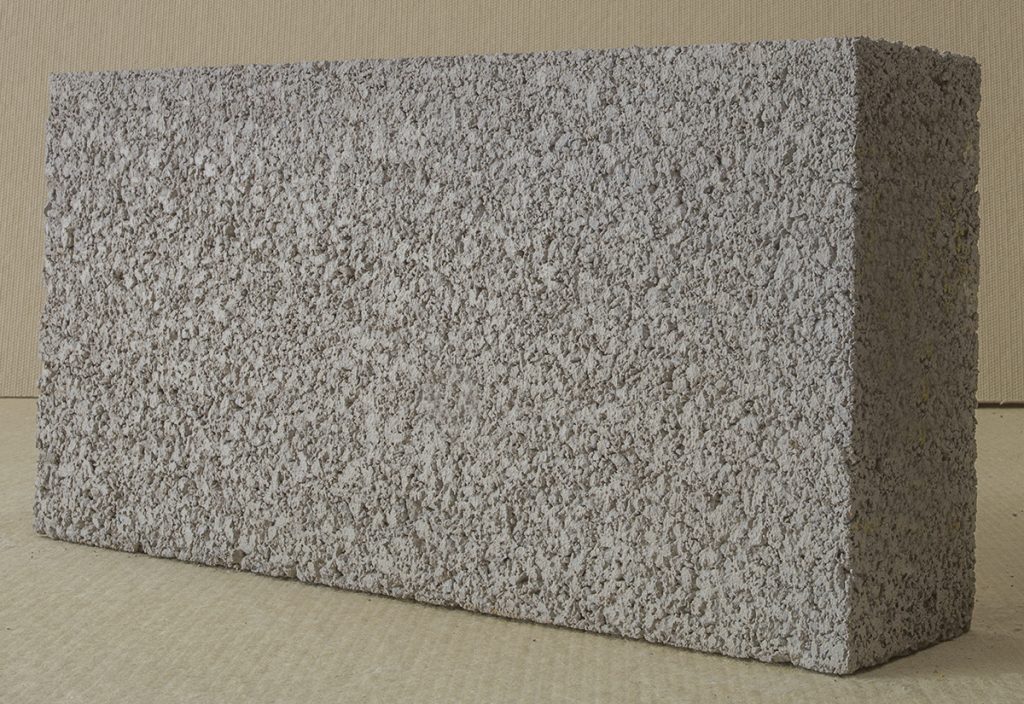
A high strength, high-density block manufactured using natural aggregates. Available in strengths from 7.3N/mm2 to 22.5N/mm2. Available in solid, cellular and hollow forms, having a textured face ideal for plastering, rendering and dry lining. Colour is concrete buff. A Close Textured (Class 1) ex- Gainsborough and Close Textured (Class 2) ex-Syston is available for walling to receive a paint finish or built fair and left.
Manufactured to EN 771-3 & associated test standards.
Key Features
Key Features of High-Strength Masonry Blocks
- High Strengths (7.3 - 22.5N/mm²)
- High Density with Excellent Sound Reduction
- Available in Solid, Cellular, and Hollow Forms
- Standard Work Face Size: 440mm x 215mm
- Strong Background for Plastering/Rendering
- Close Textured Finish for Walls Built Fair or Painted
- Durable, Robust All-Round Masonry Block
- Manufactured to EN 771-3 & Related Test Standards
Applications
Intercrete masonry units are suitable for the following uses:-
- Below DPC level including use in sulphate soil classes DS-1, DS-2 and DS-3. For use in soil classes DS-2 and DS-3, 7.3N/mm2 strength Intercrete units should be used.
- Outer and inner leaves of external cavity walls in conjunction with cavity insulation.
- Internal partition walls - load and non-load bearing.
- Separating/and party walls in accordance with Part E Building Regulations, see heading Sound Insulation.
- Infill units in conjunction with concrete beam and block floors.
- Close Textured units for walls built fair or painted.
- Retaining walls, reinforced vertically in cores of hollow units.
- Thermal Conductivity
- Thermal Resistance
- Sound Insulation
- Sound Absorption
SOLID UNITS | ||
DENSITY kg/m3 | W/mK (‘K’ VALUE) | |
MOISTURE CONTENT | ||
| 3% | 5% |
2000 | 1.33 | 1.43 |
2050 | 1.39 | 1.49 |
1525
|
Cellular units
| |
0.61 | 0.67 | |
| STRENGTHS N/mm2 | SOLID FORMAT | |||||
| WIDTHS mm | ||||||
| 75 | 90 | 100 | 140 | 190 | 215 | |
| 7.3 | 0.06 | 0.07 | 0.08 | 0.11 | ||
| 10.4 to 22.5 | – | 0.07 | 0.07 | 0.10 | ||
| CELLULAR FORMAT | ||||||
| 7.3 | 0.16 | |||||
| HOLLOW FORMAT | ||||||
| 7.3 | 0.10 | 0.10 | ||||
Resistance values of blocks of Cellular and Hollow format have been produced by computer, using calculations procedure for voided material in CIBSE Guide 1999.
| SOLID UNITS | |||||
| AVERAGE SOUND REDUCTION INDEX dB | |||||
| Wall Width mm | Fair Face | Plaster L/Weight | Plaster Dense | Dry Lined | Hollow Cellular |
| 75 | 44 | 47 | 47 | 46 | – |
| 90 | 46 | 48 | 48 | 47 | – |
| 100 | 47 | 50 | 50 | 49 | (1dB) |
| 140 | 50 | 52 | 52 | 51 | (2dB) |
| 215* | 54 | 55 | 55 | 55 | (4dB) |
Acoustic Sound Absorption Coefficients
The following data is based on Approved Document E to the Building Regulations 2000.
FREQUENCY HZ | COEFFICIENTS | |
FAIR FACED OR | PAINTED CONCRETE
| |
250 | 0.01 | 0.05 |
500 | 0.01 | 0.06 |
1000 | 0.02 | 0.07 |
2000 | 0.02 | 0.09 |
4000 | 0.03 | 0.08 |
Available in Solid, Cellular and Hollow format.
Face work size is 440 mm x 215 mm.
Tolerance as BS EN 771-3, Table 1, Tolerance category D1.
Unit length and height +3, -5mm.
Unit width average +3, -5mm.
Relationship of Density/Strength (Solid Units).
EN772-13 Gross Dry Density – Category II Materials.
7.3 N/mm2 – 2000 kg/m3.
10.4, 17.5 + 22.5 N/mm2 – 2050 kg/m3 (17.5 + 22.5 N/mm2 to special order).
Static Modulus of Intercrete Masonry is approximately 3 to 8 kN/mm2.
Coefficient of linear expansion of Intercrete is 10×10 -6 /0 c.
As tested to EN 772-14 total movement = 0.38 mm/m Class 1 Aggregate, 0.27 mm/m Class 2 Aggregate.
Declared Value 0.15N/mm2 – EN 998-2 Annex C.
EN 1745 – Table A.3 Water vapour diffusion.
Coefficients μ 5/15.
Separating and flanking walls can be built using Intercrete units with an extensive number of solutions available for both Pre Completion Testing (PCT) and Robust Detail (RD) compliance. These solutions are for use in flats and apartments as well as houses.
Wall Type 1.1
215mm wall, units laid flat – block density 1850 kg/m3, 110mm coursing, 13mm plaster finish both sides – minimum mass per unit area including plaster 415/m2.
– Intercrete 100mm solid units comply (1950 kg/m3).
Wall Type 2.1
Two 100mm wide solid leaves with a minimum 50mm cavity, unit density 1990 kg/m3, 13mm plaster finish on both room sides, 225mm coursing – min mass per unit area including plaster 415 kg/m2. 100mm Intercrete solid units comply.
These constructions are subject to Pre-completion testing.
Robust Detail Compliance
Robust Detail (RD) specifications have been developed with the aim of avoiding the need for PCT testing. Builders can select a RD from a growing list of specifications and providing each plot is registered with Robust Details Ltd, PCT can be eliminated. Intercrete units can be used in a number of RDs. These constructions comprise two leaves of 100mm Intercrete solid units, with a minimum 75mm cavity, and include options for plastered or drylined finishes. Further information on all Robust Details can be found at www.robustdetails.com.
Intercrete solid units can be used in the following RD specifications.
- E-WM-1 (Plaster, minimum 75mm cavity)
- E-WM-3 (Render and plasterboard, minimum 75mm cavity)
- E-WM-16( Render and plasterboard, minimum 100mm cavity)
- E-WM-18 (Plaster, minimum 100mm cavity)
- E-WM-19(Render and plasterboard, Monarfloor Bridgestop system, minimum 100mm cavity)
For both Approved Document E and Robust Detail specifications, 100mm width Intercrete solid units can be used on the inner leaf as a compliant flanking wall solution, allowing continued use of familiar construction methods.
Lightweight plaster. Suitable undercoats include British Gypsum’s Thistle Bonding, Thistle Hardwall and Thistle Tough Coat. The finishing coat can include Thistle Multi-Finish or similar.
Dense plaster. A backing coat of 1:1:6 cement: lime: sand or 1:5 to 6 cement: sand,with added plasticiser with a setting coat of gypsum plaster, e.g. Thistle Multi-Finish or similar.
Depending on exposure conditions, it may be necessary to treat the surface with a spatterdash coat of 1:1 cement: sand: followed when dry and hard with a backing coat 10mm thickness of 1:1:6 cement: lime: sand, ruled out, and lightly scratched. A final or subsequent coat of 5 mm thickness using the same mix finished with a wood float, is applied. All types of paint finishes are satisfactory.
In housing where walls are often plastered, ceramic tiling is fixed with proprietary adhesive. In buildings other than housing, the wall is rendered using a mix of 1:4 cement: sand, ruled out level, and the tiles are fixed using an adhesive. Adequate drying time should be given to the render coat before tiling commences.
Intercrete Close Textured units can be painted directly using cement or water-based paints. An economic finish can be achieved using a mist coat (diluted emulsion) followed by 2 coats of emulsion. The paint can be brush or spray applied. The opacity will depend upon the quality of the paint and the number of coats applied.
Drylining using Gypsum Wallboard or similar, fixed either by adhesive dabs, or screw fixing to metal firrings, or nailing to timber battens. If required, thermal laminate plasterboards can be used, fixed in accordance with the manufacturer’s recommendations.
Cutting:
Cut with a bolster. Use of mechanical cutting lowers wastage and enables cleaner cuts when fair face work is involved. Norton Clipper masonry saws or similar are recommended. Chasing dense concrete masonry is laborious and should be avoided where possible. If unavoidable it should be carried out using mechanical means.
Chasing:
For fast efficient chasing, use a disc cutter or Kango electric hammer with chasing bit.
Fixings:
Use masonry nails or screw fixings and proprietary plugs into standard strength material. Masonry nails may be required into high strength material. Joint mortar can be utilised for minor fixings.
Interfuse Ltd operates a formalised Quality Assurance system at both Syston and Gainsborough plants. All masonry units are subject to stringent quality control checks and are tested daily in our own laboratory. A documented factory production control system is in operation with regular checks made on raw materials, production and finished units. A stock control system is in operation with written procedures for non-conforming products. All products are produced to the current European Standards.
Each pack is marked for traceability of product and unit clarification, as given on the delivery ticket.
The environmental impact of Intercrete constructions can be assessed by referring to BRE’s Green Guide to Specification, with many constructions achieving the highest A or A+ rating.
At the end of the life of the building, Intercrete units, which are inert, can be crushed down and recycled. Their use in buildings will far exceed the usual 60-year design life expectancy, making Intercrete a very sustainable material.

Download Brochure
- Product Range
- Fire Resistance (Hours)
- Recommended Mortar Mixes
- Delivery / Data Load
FORMAT SOLID | CELLULAR | HOLLOWS | |||
WIDTH | STRENGTH N/mm2 | STRENGTH N/mm2 | |||
mm | 7.3 | 10.4 to 22.5 | 7.3 | 7.3 | |
75 | 14.2 kg(154) | ||||
90* | 17.4 kg(180) | 17.9 kg (190) | |||
100 | 19.4 kg(201) | 19.8 kg (212) | 14.0 kg (150) | ||
140 | 27.0 kg(290) | 27.0 kg (296) | 18.3 kg (198) | ||
215 | 19.8 kg (220) | ||||
DENSITY | 2000kg/m3 | 2050kg/m3 | 100mm 1525kg/m3 | 140mm 950kg/m3 215mm 950kg/m3 | |
The following Fire Resistance table is based upon EN 1996–1–2: 2005, Tables NA.3.1 and NA.3.2. These are valid for walls without finishes, designed to EN 1996,Part 1–1.
BLOCK THICKNESS (mm) | |||||||
| (Criteria) | 75 | 90 | 100 | 140 |
|
|
SOLID UNITS – ANY STRENGTH | |||||||
NON-LOADBEARING | (E1) | 1 | 2 | 4 | 4 | – | – |
LOADBEARING | (RE1) | – | 1.5 | 2 | 3 | – | – |
CELLULAR UNITS | |||||||
NON-LOADBEARING | (E1) | – | – | 1 | – | – | – |
LOADBEARING | (RE1) | – | – | 1 | – | – | – |
HOLLOW UNITS | |||||||
NON-LOADBEARING | (E1) | – | – | – | 4 | – | 4 |
LOADBEARING | (RE1) | – | – | – | 3 | – | 4 |
Suitable mortar mixes for use with Intercrete units are shown in Table 6. The thickness of mortar joints should be approximately 10mm.
LOCATION | MORTAR DESIGNATION | COMPRESSIVE STRENGTH CLASS | PRESCRIBED MIX |
WORK ABOVE DPC | (iii) | M4 | 1:1:6 cement: lime: sand, or 1:5 to 6 cement: sand* |
WORK BELOW DPC | (iii) | M4 | 1:1:6 cement: lime: sand, or 1:5 to 6 cement: sand* |
(ii) | M6 | 1½: 4 to 4½ cement: lime: sand or 1:3 to 4 cement: sand* | |
| * Mixes can be used with or without air entrainment. Plasticisers should be used only with the designer’s approval and should be gauged in accordance with the manufacturer’s written instructions. | |||
Prices quoted per 10 units (9.88 blocks per m2). All prices include mechanical off-loading and apply to full loads. Load sizes may vary between 19 tonnes Rigid, 24-27 Artics.
| INTERCRETE SOLID 7.3N TO 22.5N/mm2 | |||||
WIDTHS mm | 75 | 90 | 100 | 140 | Coursing Units |
APPROX No OF UNITS PER 19 TONNE LOAD | 1344 | 1040 | 1008 | 672 | 6084 |
24 | 1632 | 1360 | 1296 | 864 | 7956 |
27 | 1920 | 1520 | 1512 | 960 | 8892 |
UNITS PER PACK | 96 | 80 | 72 | 48 | 468 |
CELLULAR & HOLLOWS 7.3N/mm2 | |||||
WIDTHS mm |
| 100 | 140 | 215 | HIGHER STRENGTH UNITS SUBJECT TO SPECIAL QUOTATION PART LOADS ARE SUBJECT TO SPECIAL QUOTATION |
APPROX No OF UNITS PER 19 TONNE LOAD |
| 1170 | 1020 |
| |
24 |
| 1440 | 1320 | 960 | |
27 |
| 1620 | 1440 | 960 | |
UNITS PER PACK |
| 90 | 60 | 40 | |